
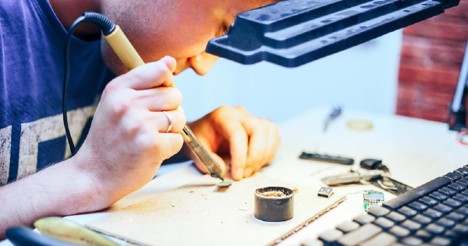
Solder paste selection plays a critical role in the success of Printed Circuit Board (PCB) assembly. Acting as the “glue” that connects surface mount components to the board, solder paste ensures robust electrical connections, mechanical stability, and reliability. However, choosing the right solder paste can be a challenge, as there are many different options available. From paste composition to particle size, every detail influences the efficiency and durability of the finished PCB.
Let’s explore why solder paste selection is so important in PCB assembly and what factors to consider when making your choice.
Why Solder Paste Selection Matters
Solder paste isn’t a one-size-fits-all product. Each paste has unique properties designed to work in specific environments, assembly processes, and applications. Choosing the wrong solder paste can lead to a range of issues, from weak connections to excessive waste, potentially compromising the functionality of the entire circuit. Selecting the right solder paste not only improves production efficiency but also ensures the final product meets performance and reliability standards.
Key Factors in Solder Paste Selection
When selecting a solder paste for printed circuit board assembly, several factors come into play:
Solder Composition
The choice between leaded and lead-free solder paste depends on regulatory requirements, environmental considerations, and application needs. While leaded solder paste offers strong, reliable bonds, lead-free alternatives are increasingly popular due to environmental regulations and health concerns. However, lead-free solder pastes require higher reflow temperatures and precise thermal profiles, making them slightly more challenging to work with.
Flux Type and Activity Level
The flux in solder paste removes oxides and impurities on component and board surfaces, allowing for proper soldering. Flux types include no-clean, water-soluble, and rosin-based options, each suited to different needs.
For instance, no-clean flux leaves minimal residue, reducing the need for post-solder cleaning. This is why we recommend it for simple, low-cost assemblies. Water-soluble fluxes, on the other hand, require cleaning but are effective for high-reliability applications, such as aerospace and medical devices, where any residue could impact performance.
Viscosity and Printability
Solder paste needs to be printable and maintain its shape on the PCB during the printing process. Viscosity is influenced by factors like temperature and humidity, so selecting a paste with appropriate viscosity ensures consistent stencil printing and proper component placement. High-viscosity pastes are suitable for intricate designs with fine-pitch components, while lower-viscosity pastes may be preferable for larger components and simpler layouts.
Particle Size and Alloy Composition
The paste’s particle size, often categorized by type (Type 3, Type 4, etc.), is crucial for surface mount technology (SMT) assemblies, especially with fine-pitch components. Smaller particles (e.g., Type 4 or Type 5) provide better print definition for intricate designs, but they can be more expensive. Choose a composition that aligns with the reflow profile and performance expectations of your project.
Thermal Profile Compatibility
The reflow process must match the thermal profile of the solder paste to achieve effective soldering. Lead-free solder pastes, for instance, require higher peak temperatures, which may affect component and board materials. Choosing a paste compatible with your equipment and thermal profile ensures that connections are strong and void-free.
Tips for Choosing the Right Solder Paste
Selecting the right solder paste requires a combination of knowledge and experimentation. Here are a few tips to help guide your choice:
- Understand Your Application Requirements: Consider the environment and regulatory requirements for your product. High-reliability applications may require lead-free or specific flux types, while cost-sensitive projects may benefit from no-clean pastes.
- Test and Evaluate: Whenever possible, test different solder pastes on sample boards to see how they perform. Evaluate the paste’s printability, adhesion, and performance in reflow to determine which option provides the best results.
- Consult with Your Supplier: Solder paste suppliers have extensive knowledge about their products and can offer recommendations based on your specific needs. Consulting with them can provide valuable insights and streamline the selection process.
- Consider the Impact of Design Changes: If your PCB design changes, review your solder paste selection. Changes to pitch size, component types, or layout density may require a different solder paste type to ensure optimal performance.
Conclusion
Solder paste selection is a critical step in PCB assembly that directly impacts product reliability, performance, and cost. By understanding the various types of solder pastes and evaluating factors like composition and thermal compatibility, manufacturers can produce durable, high-quality PCBs. To get a free quote on your PCB project, contact Sonic Manufacturing today. We will make sure that your solder paste aligns with the goals of your assembly process.